Posted

James Bond is almost synonymous with Aston Martin, and his newest ride, the Aston Martin DB10, is a gorgeous one-off created specifically for the movie Spectre. It calls to mind the glorious DB5 from Goldfinger, a car that is almost as iconic as 007 himself.

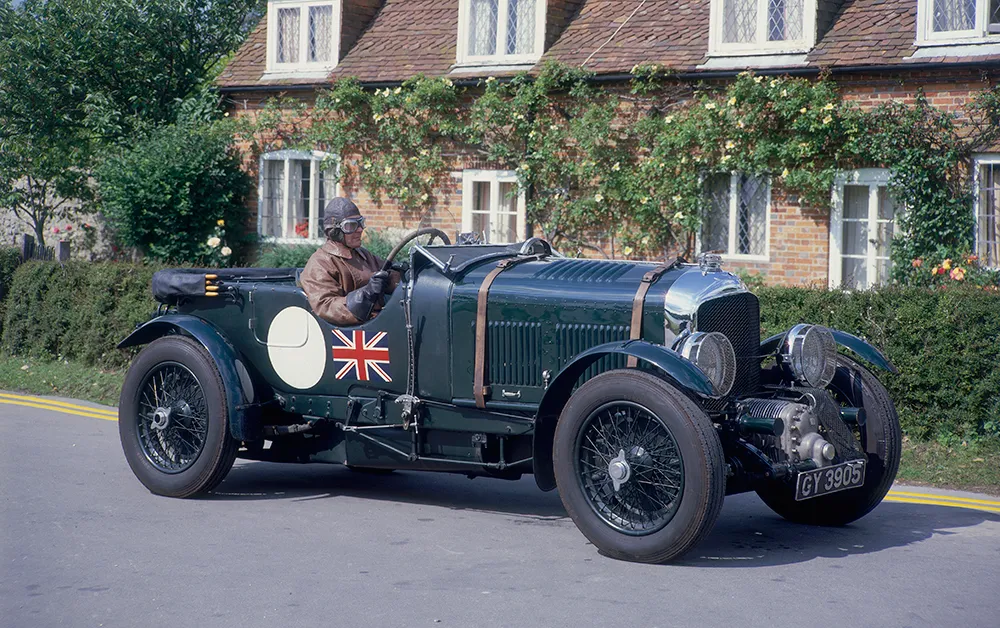
But before James Bond was the dashing and debonair secret agent on the silver screen, he was the tormented and brooding assassin of Ian Fleming’s novels. And in those books, he drove a Bentley. In Fleming’s first 007 novel, Casino Royale, published in 1953, Bond tooled around in a 1931 4.5 Litre Blower Bentley. It wasn’t so sleek or sexy as the Astons that Bond would come to be known for, but it was among the finest cars of its day and just the thing for getting around in all due haste with style.

Bond was, in Casino Royale, something of a car nut and his beloved Bentley was “his only personal hobby.” He bought it in 1933 and kept it in storage while serving in World War II. “Bond drove it hard and well and with an almost sensual pleasure.”

Built by Sir Henry “Tim” Birkin, one of the famous “Bentley Boys” who raced the cars at Le Mans, the supercharged, two-ton Blower was based on the brand’s 24 Hours of Le Mans race car. It produced 240 horsepower from a 4.4-liter inline-four motor with a four-speed unsynchronized manual transmission. The supercharger, which forced more air into the engine to generate more power (thus “Blower”) was gigantic and easily spotted at the front of the car, between the headlights. Top speed was in the 120 mph range, impressive for the era. Just 55 supercharged units of the car were produced between 1929 and 1931.

Despite the Blower’s success, Walter Owen Bentley, founder of the company, was actually quite disappointed by the car. He strongly disliked forced induction and believed there is no replacement for displacement. But he had by that point lost control of his company and was powerless to stop Birkin’s work.

So why the shift from Bentley to Aston? According to Top Gear’s 50 Years of Bond Cars special, Fleming received a letter from a fan who encouraged the author to “have the decency to fix him up with a decent bit of machinery.” The chap suggested an Aston Martin DB3. Fleming made the switch in 1959’s Goldfinger, and when the famous film was made in 1964, the producers went for the more current DB5. The rest, as they say is history.

Blower Bentleys can fetch well over a million dollars these days, with the famous DB5’s commanding quite a bit more. The DB5 used in Goldfinger and Thunderball sold for $4 million at auction a few years ago.

Author


Posted

A UK petrol company has launched a new ‘biofuel’ which it claims is designed to work in classic cars – but the emissions-reducing petrol blend comes at a hefty premium compared to unleaded from the regular fuel bowser.

British start-up Coryton markets its biofuels – which contain a blend of unleaded petrol and bio-organic compounds from agricultural waste – as ‘Sustain Classic’, claiming it can reduce tailpipe emissions of classic cars by “at least 65 per cent”.

While the company’s focus is selling its fuel to classic-car owners, it does not say why its product works better in older vehicles than existing biofuels – or regular unleaded petrol – on the market.

Coryton sells three ‘levels’ of biofuels: ‘Super 33’ and ‘Super 80’ contain 98-octane unleaded petrol and 33 to 80 per cent renewable content respectively, while the company’s flagship ‘Racing 50’ is a blend of 102-octane motorsport fuel and 50 per cent renewables.

However, Coryton’s biofuels come at a substantial mark-up compared to ‘regular’ 98-octane petrol in the UK and Australia.

Super 33 starts at £3.80 ($7.25) per litre and Super 80 costs £4.65 ($8.85) per litre – with Racing 50 setting buyers back £5.24 ($10) per litre.

Despite its high price, Coryton has secured a contract to supply its biofuels to at least one high-profile client in the UK, with the British division of Japanese car-maker Mazda now using the petrol to run its fleet of heritage vehicles.

In a media statement, Mazda UK said its press vehicle fleet – which includes 15 cars, from an classic RX-3 rotary coupe to MX-5 convertibles from the 1990s and 2000s – will be filled with Super 80 “each time the cars are driven or loaned to media”.

There are also just two ‘sustainable’ fuels available from petrol stations in Australia: E10 – which is the most common and contains 10 per cent ethanol – and E85, the latter of which is mainly used in modified high-performance cars. With both E10 and E85, a car’s fuel economy is also reduced due to ethanol containing lower energy levels than petrol.

Author


Posted

Save The Date – Saturday 21st & Sunday 22nd October 2023
Great Eastland Hub Rally 2023 – to be hosted by Tamworth & Districts Antique Motor Club.
There will be a drive in the Tamworth District on the Saturday & Sunday mornings.
More information & Entry Forms will be sent to clubs soon.

Click here to contact Tamworth & Districts Antique Motor Club by email.
Further updates will be available shortly on the club Events page.

Author


Posted

As you may be aware, our club now has it’s own YouTube channel. Our first video is from Mid Coast Ford Motorfest, held on Sunday 11th June 2023, we hope you enjoy it…

Author